





Frequency-enhanced dual-graph modeling with reinforcement learning for wind power forecasting
发布时间:2026-09-20
点击次数:
- 影响因子:
- 5.7
- DOI码:
- 10.1016/j.chaos.2026.119197
- 发表刊物:
- Chaos, Solitons & Fractals
- 关键字:
- Wind power forecasting; Frequency domain enhancement; Stable-dynamic graph learning; Reinforcement learning; Interpretability
- 摘要:
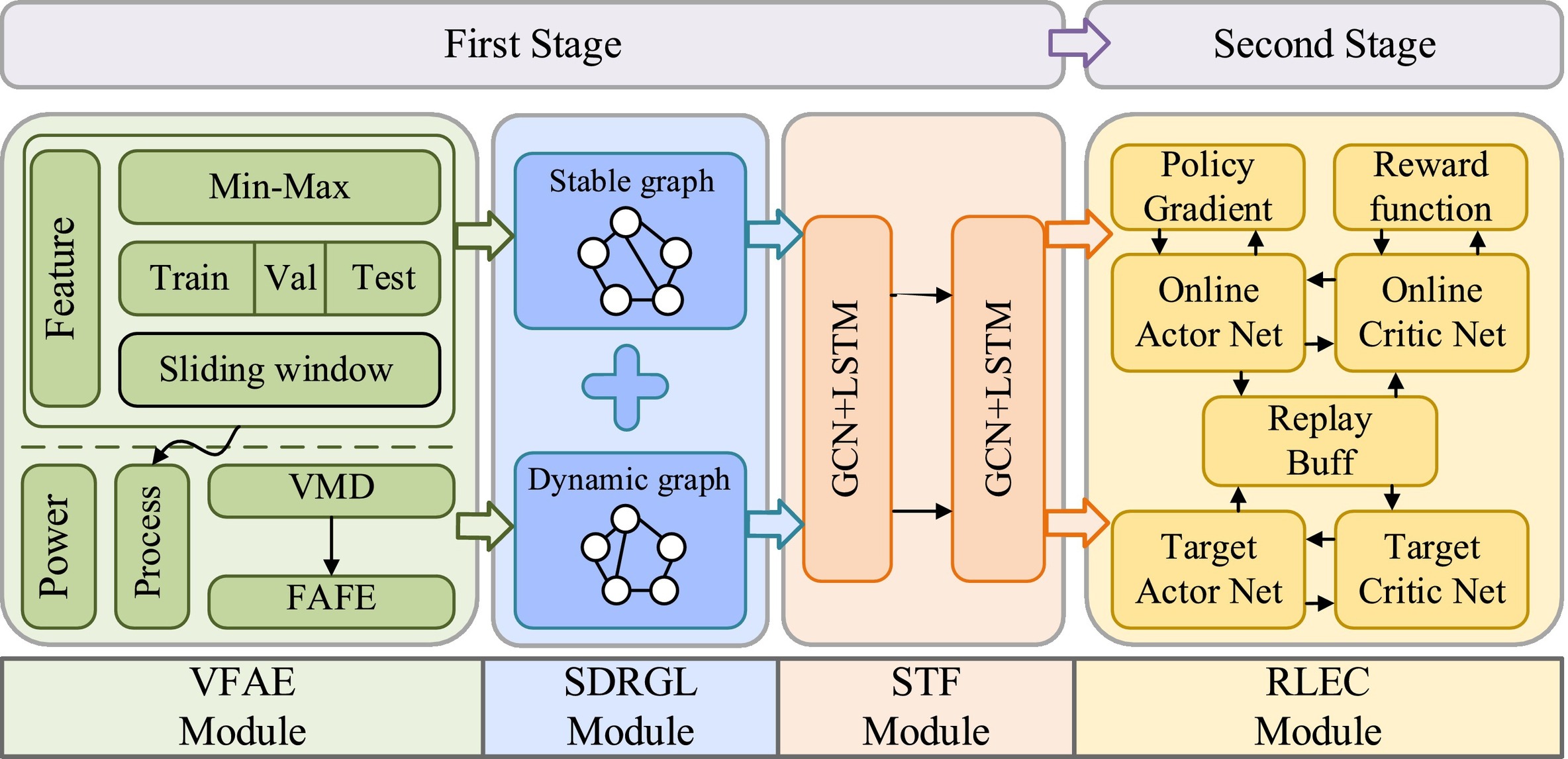
- Accurate wind power forecasting is essential for secure grid operation and large-scale wind energy integration. However, existing methods inadequately exploit frequency-domain information, jointly characterize stable and time-varying meteorology–power relationships, and robustly correct residual errors under complex conditions. To address these issues, this study proposes a two-stage hybrid framework comprising deep spatiotemporal initial forecasting and reinforcement learning-based state-conditioned correction. In the first stage, Variational Mode Decomposition (VMD) and Fourier-domain attention construct a frequency-aware wind power representation, which is integrated with meteorological variables as graph nodes. Stable–Dynamic Relational Graph Learning (SDRGL) separately captures globally shared stable dependencies and input-dependent dynamic interactions and adaptively fuses them through a gating mechanism. A relation-guided Graph Convolutional Network–Long Short-Term Memory network (GCN–LSTM) then aggregates cross-variable information and models temporal dependencies to generate the initial forecast. In the second stage, a Deep Deterministic Policy Gradient (DDPG) agent learns a continuous correction policy from the initial forecast, meteorological conditions, and historical correction information. Experiments on four seasonal datasets show that, compared with the best competing model in each season, the proposed method reduces Root Mean Square Error (RMSE) and Mean Absolute Error (MAE) by 12.95%–32.10% and 14.15%–33.09%, respectively, while maintaining favorable cross-regional generalization. Ablation studies verify the contributions of frequency enhancement, stable–dynamic relational learning, gated graph fusion, and state-conditioned correction. Visualization results further show that several learned patterns are consistent with established meteorology–power relationships, supporting interpretation of model behavior.
- 论文类型:
- 期刊论文
- 论文编号:
- 119197
- 学科门类:
- 交叉学科
- 文献类型:
- J
- 卷号:
- Volume 213
- 期号:
- Part 1
- 页面范围:
- 1-29
- 是否译文:
- 否
- 发表时间:
- 2026-01-01
- 收录刊物:
- SCI、SSCI